


Civilization is Stalling
 By donghoang
March 18, 2026
By donghoang
March 18, 2026
In recent times, we constantly hear stories about AI: “AI will replace humans,” “AI changes humanity,” “AI destroys the world”… But very few people stop to ask themselves: “What am I doing in this whole story?”
Out of more than 8 billion people on Earth, perhaps fewer than 1 billion are actually directly and consciously impacted by AI in their daily lives. These are people with an average standard of living or higher, mainly in developed countries or the urban middle class.
The rest—billions of farmers, factory workers, children in Africa, residents of the Gaza Strip, or families struggling day and night to make a living—AI almost does not exist as a concrete concept in their lives.
It is not because AI has absolutely no impact on them, but because they have never actually interacted with or been aware of its existence. They still have to plow fields, sow seeds, perform manual labor, and find food and water every day—activities that cannot be replaced by data or algorithms alone.
For these people, if AI appears at all, it is simply a tool to help find information a bit faster or more accurately—nothing more. It does not plow the fields for them, it does not grow rice, it does not build houses, and it does not raise children. It does not replace manual labor—the thing that remains the foundation for sustaining the life of all humanity until now.
Much of this comes from the media and hype campaigns—where AI is often described as an almost omnipotent entity or an existential threat.
But the most concerning thing does not lie in whether AI is strong or weak; it lies in how it is silently changing the very people in whom society has invested the most: the elite, intellectuals, leaders, researchers—those who play the role of orienting and leading civilization.
They are gradually becoming dependent on AI as a “replacement thinking” system. Instead of using AI as a support tool, they have begun to delegate the act of thinking to it: from writing and analysis to decision-making. In many cases, they no longer truly verify information or understand the nature of the problem, but merely repeat what the AI provides in a more polished form.
That is the most notable step backward: when the capacity for independent thinking—the core foundation of progress—begins to be eroded.
AI, in its essence, is just a tool created by humans—a system for processing and recombining information at high speed. But the paradox lies here: humans are gradually turning themselves into tools dependent on that very system.
The problem does not lie in the technology, but in how we use it: in the media, in speculators, in those who paint an exaggerated vision of AI to hide a very simple truth:
Society still needs food, still needs farmers, and still needs physical labor to exist. No layer of data and models, no matter how complex, can replace those physical foundations.
One of the clearest consequences that has been and is happening: the amount of AI-generated content is increasing exponentially and flooding the internet.
Most of it does not create new knowledge but is merely a recombination of what already exists—a form of “information noise” presented under a rational and coherent guise.
This content creates countless “traps”:
- The time trap (consuming attention),
- The thinking trap (reducing the need for deep thought),
- The creativity trap (making humans easily satisfied with ready-made solutions).
As humans spend more time on these layers of content while simultaneously reducing independent thinking and physical labor, the speed of creating new knowledge slows down. And when the class that creates knowledge slows down, the entire civilization is pulled down with it—silently but continuously.
We are gradually excluding ourselves from the very civilization we built.
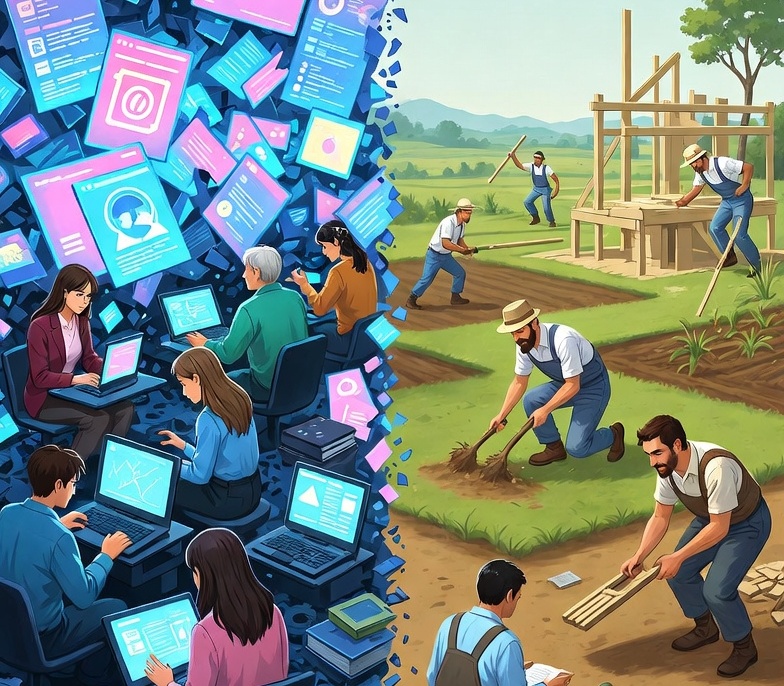
AI does not destroy humanity in a science-fiction way. It does not need to. Instead, it is creating an invisible filter, dividing humanity into two parallel worlds:
- A world living in an illusion created by AI—where humans consume data, images, and instant answers, but create less and less real value.
- A world that still exists in the true civilization of mankind—where labor, food, and independent thinking remain the foundation.
So, which world are you living in?