





Humans are Losing the Capacity for Independent Thinking in the AI Era
 March 23, 2026
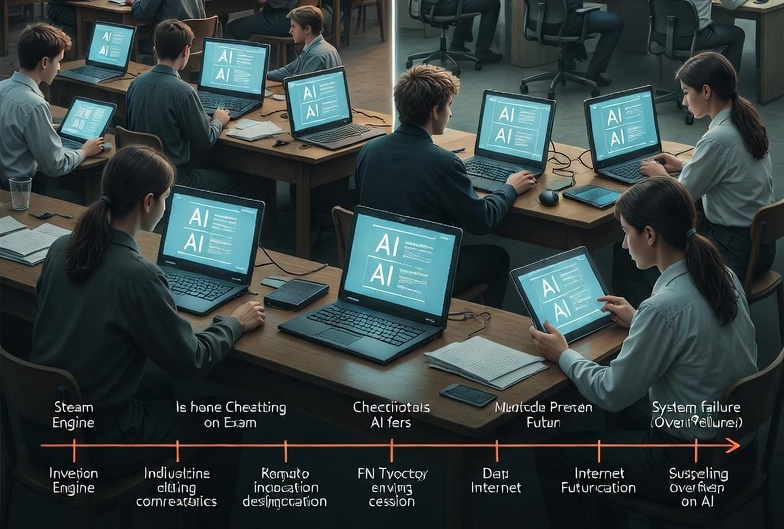
In just over 100 years, humanity has witnessed leaps of progress unprecedented in history. Three consecutive industrial revolutions—from steam power and electrification to information technology and automation—have fundamentally transformed the economy, science, healthcare, and social life.
When AI (particularly Large Language Models like ChatGPT) emerged in late 2022, many expected a “Fourth Industrial Revolution.” However, reality is showing signs of the opposite: instead of augmenting human intellect, AI is gradually replacing it. This is the result of documented scientific phenomena: cognitive offloading and automation complacency.
The core issue lies in how we use AI: instead of viewing it as a labor-saving tool, humans are misusing it as a substitute for thought.
1. The Greatest Danger: AI Abuse in Education – The Critical Stage of Cognitive Development
Schooling is the period when the human brain is at its most plastic (neuroplasticity). Solving math problems, debating, and writing essays are the very processes that forge critical thinking, creativity, and accountability.
According to Pew Research Center surveys:
- 2023: Only about 13% of teens (ages 13–17) had used ChatGPT for schoolwork.
- 2024–2025: That figure doubled to 26%.
- Latest Survey (Sept–Oct 2025, published Feb 2026): More than 50–57% of U.S. teens have used AI chatbots for schoolwork assistance, with 54% using them to actually complete assignments.
In the UK, the number of university students caught cheating via AI has surged. Nearly 7,000 cases were confirmed in the 2023–2024 academic year (5.1 cases per 1,000 students), a threefold increase from the previous year. By May 2025, the rate is projected to reach 7.5 cases per 1,000.
UNESCO issued a stark warning in 2023 (Guidance for generative AI in education and research) and reinforced it in their 2026 report, “AI and the Future of Education: Disruptions, Dilemmas, and Directions”: If left unchecked, AI will lead to “cognitive surrender,” eroding learners’ independent thought, critical inquiry, and humanity. The report emphasizes: “What matters is what the student understands and whether they can evaluate what AI gave them”—yet students are moving from thinking to merely “asking AI.”
Scientific studies confirm that students using LLMs experience cognitive offloading but demonstrate significantly poorer reasoning and analytical skills. A 2025 MDPI study showed a clear negative correlation between AI usage frequency and critical thinking skills, with cognitive offloading acting as the primary mediator.
2. In Professional Environments: Productivity Pressure Leading to Passivity
Competitive pressure forces businesses to increase output and cut costs. Combined with inflated expectations of AI, employees—particularly Gen Z and Gen Alpha—are outsourcing their entire thought processes to machines.
The Deloitte Global 2025 Survey (23,000+ respondents across 44 countries) reveals:
- 57% of Gen Z and 56% of Millennials use generative AI daily at work.
- 74% of Gen Z and 77% of Millennials believe GenAI will change their workflow within the next year.
- Forbes adds: 46% of Gen Z believe AI provides better guidance than their managers; 38% rely entirely on AI to complete daily tasks.
The EY Work Reimagined Survey 2025 (15,000 employees, 29 countries) found that 37% of workers fear that overreliance on AI will erode their own deep, specialized expertise.
The consequences are scientifically proven through deskilling and automation bias:
- MIT & The Atlantic (2025) Research: Frequent AI users often achieve better short-term results, but their long-term problem-solving and critical thinking skills decline sharply.
- BMJ Evidence-Based Medicine (2025): Warns that overreliance on AI reduces the critical thinking of medical students and junior doctors.
The younger generation works faster thanks to AI, but they struggle to audit, correct, or explain the output—leading to catastrophic errors when systems encounter unpredictable edge cases.
3. Long-term Consequences: The “Invisible Gap” and Systemic Collapse
There is no obvious disaster yet. However, in the next 5–10 years, as AI systems are deployed at a “black-box” level, accumulated vulnerabilities will become a “tsunami.”
CNBC (March 2026) calls this “silent failure at scale”: “Autonomous systems don’t always fail loudly. It’s often silent failure at scale.” Systems don’t just crash; they drift, misapprove, or lose context—and eventually, no one understands the underlying mechanism enough to fix it.
Research on AI overreliance (Atlantic, ACM, Springer 2025) warns of cognitive atrophy, loss of brain plasticity, and a society gripped by “learned helplessness.” When AI fails en masse (due to hallucinations, bias, or cyberattacks), there will be no human workforce capable of stepping in.
Humans are trading their “greatest power”—the capacity for independent and creative thought—for short-term convenience. History has proven that technology only truly progresses when humans remain in the lead.
A Question for You: In your current professional capacity, are you trusting yourself, or are you abdicating your mind to AI?
Your answer today will determine not only your personal future but the destiny of humanity in the age of artificial intelligence. We must use AI as a tool, not as a second brain.